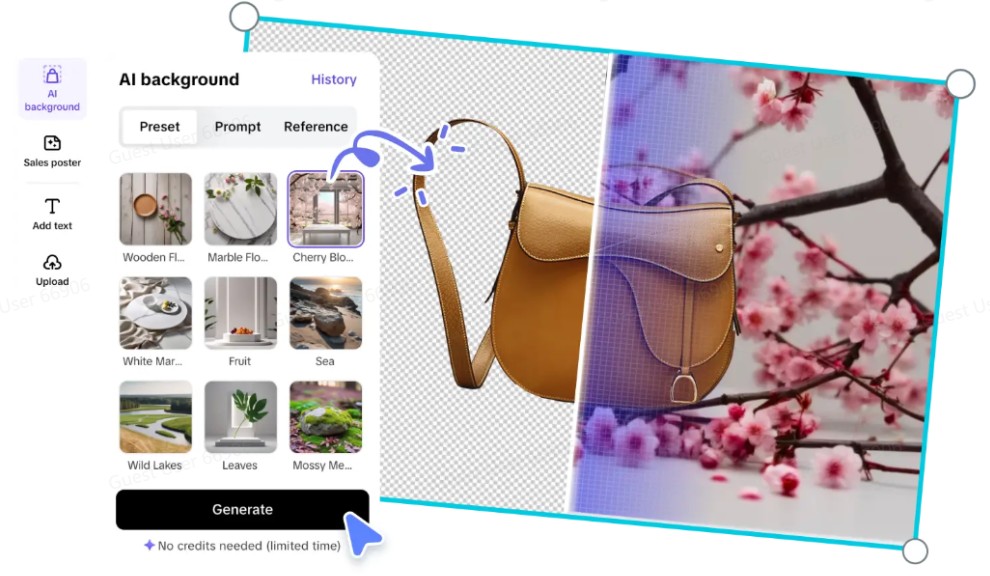
Creating new images again and again may be a tedious process for advertisers and content creators. Every campaign will need dissimilar pictures, yet uniformity among the various platforms is likely to hinder the output. Creating good visuals is time-consuming, labor-intensive, and in most instances, the outcome of such an exercise will be inconsistency, which will be experienced in brand recognition. Here, scalable marketing is based on reusable assets. They provide a platform on which images can be built up with campaigns and conserve a significant portion of creative strength. Social networks like Pippit simplify the process by offering tools that allow one to create repeatable visual systems within a short period. By leveraging the capabilities of an AI background generator, marketers can build visual libraries that remain versatile across multiple projects, ensuring brand consistency and creative efficiency over time.

What Makes a Visual Truly Reusable
A visual is reusable when it is possible to apply it to other platforms, campaigns, and situations and retain its effectiveness. Adaptability is essential. The image must work well on posts, banners, adverts, and e-commerce listings. Neutral backgrounds but complementary to brand identity enable it to be more straightforward to implement new messages or products without re-creating the entire asset. Modular design principles are also imperative since they allow independent components to be substituted, enlarged, or even repositioned without disturbing the visual harmony. Reusable pictures can also have a unified aesthetic in terms of brand tone, either minimalistic, colorful, or luxurious. This standardization reduces the artistic tension of repacking resources by campaign and offers the audience an identical appearance.
AI Backgrounds as a Foundation for Visual Systems
AI-generated backgrounds can be used as a reference point for scaled visual systems. Creating standard images that can be adapted to different campaigns will imply that the content will be the same, but open to new ideas. The lighting, tone, and composition should remain similar in these backgrounds because any contrast in these backgrounds breaks brand continuity. Pippit is letting marketers generate a full visual library, and every background is a reusable canvas for future campaigns. Using this library, you will be able to come up with many variations of a single idea, select the most efficient foundation, and apply it with minor changes in different marketing platforms. The approach reduces duplication of work, enhances visualization, and professionalism in the long term.
Designing Background Templates with AI
The AI usage in the creation of the background templates gives it consistency across the project in the preset. It is also possible to create custom styles by prompts capturing the brand identity, but flexible enough to support a variety of use-cases, as shown by Pippit. Once a template has been created, it can be utilized as a foundation for various visuals, and time is conserved on monotonous design tasks. AI-generated backgrounds can also be tried in terms of textures, gradients, and colors, which might be difficult to produce manually. Designers do not need to recreate base visuals repeatedly, but they can focus on the addition of a new object or message. This method accelerates content creation and provides a cohesive system that grows alongside marketing needs, which is especially useful when combined with tools like a free AI video editor for dynamic promotional campaigns.

Steps to Build reusable visuals using an AI background generator
Step 1: Import base images for long-term use

Sign up for the Pippit AI generator background and access “Image Studio” from the left panel. Click on “AI Background” under “Level up marketing images” and upload your base product or brand images using drag and drop or “Device”. Sample photos are also available if you want to experiment with layouts first.

Step 2: Design flexible and reusable backgrounds

The AI Background tool removes the original background instantly. Choose consistent styles from “Preset”, upload branded visuals through “Reference”, or generate adaptable designs using “Prompt”. Click “Generate” to preview four background versions and select one that works across campaigns. Apply “AI design” to create reusable promotional formats or use “Add Text” for editable captions.

Step 3: Export assets for future campaigns
Once finished, click “Download” in the top-right corner. Select the file format and size suitable for repeated use, then click “Download” to save the visuals to your device. You may export them with or without a watermark, depending on how you plan to reuse them.

Repurposing Visuals Across Marketing Channels
Base visuals can be applied effectively when they are produced and reused across different marketing platforms. Social media posts, banners, product listings, and advertisements can be edited on the same picture without necessarily having to re-edit the original picture. This allows the campaigns’ rollouts to be faster and more uniform. The visual identity of the brand does not disappear because the main design could be the same, and the messaging could be changed dynamically. Pippit and other products can easily be adjusted, such as changing colors, lighting, or even adding text to an existing background. This strategy not only streamlines workflows but also maximizes the value of each visual asset, especially when integrated with broader content tools such as a video agent for multimedia campaigns.

Maintaining Brand Consistency Over Time
Recognition and trust are based on the consistency of the brand. Graphics that are reusable offer uniformity across product lines and advertising campaigns, regardless of the time or the medium. Background matching brand themes with the help of AI reduces the gaps in discrepancies and creates an overall aesthetic. The fact that campaigns can be edited without losing their core means that they are not subject to the visual drift that is typical of fast-evolving marketing environments. This approach of Pippit ensures that each of the backgrounds created is aligned to brand guidelines, and, hence, it is easier to maintain visual balance and apply innovative creative concepts. The level of control allows the long-term marketing strategies that do not overburden the creative teams.
Long-Term Efficiency Gains with Reusable Assets
The payoffs of the creation of reusable images are enormous in the long run. It lessens the burden of creativity and liberates a greater focus on strategy and messaging. It will be faster to update the content as the underlying visuals will be standardized and adaptable. The distribution of resources can be more efficient, and the dependency on the continuous design work when a new campaign is being held is reduced. The integration of AI solutions will ensure that the usual processes, such as designing backgrounds or the algorithm for modifying assets, are automated without a deterioration in quality. A sustainable marketing operation is based on reusable visual assets in the long term, where it is possible to scale and have a uniform brand across the channels.
Conclusion
Visual re-use is not a choice, but a requirement of scalable marketing. The AI-based background generation provided by platforms like Pippit makes it easier to be more consistent, efficient, and flexible between campaigns. As the library of reusable backgrounds and templates is developed, marketers can reduce the amount of work done on the same piece of content, speed up the release of content, and preserve brand integrity over time. With the integration of these AI tools into the operation, we can create long-term sustainable visual systems, developing with the marketing strategies existing and leading to the long-term creative and operational success.